
Permanent Retainers
Benefits, Care and Common Problems
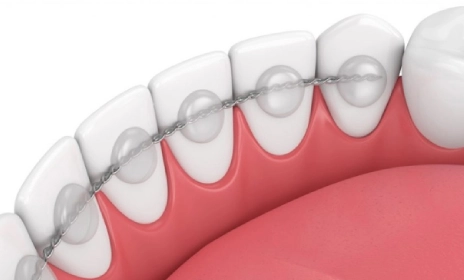
A permanent retainer is a thin wire bonded behind selected teeth to help maintain their alignment after orthodontic treatment. It remains in the mouth and works continuously, so its effectiveness does not depend on remembering to insert it each night.
Permanent retainers can provide reliable long-term support, particularly in areas considered likely to shift. They also require careful cleaning and regular checks because a bond may fail without the entire wire coming loose.
Is a Fixed Retainer Really Permanent?
Permanent, fixed and bonded retainers are terms commonly used for the same type of appliance.
“Permanent” means you do not remove it yourself. It does not mean the retainer is guaranteed to last for life or never require repair.
The wire is usually attached to the tongue-facing surfaces of selected front teeth. Depending on the design, it may be bonded to every tooth it crosses or secured at specific points.
Because it does not normally include every tooth in the arch, a fixed retainer may be combined with a removable one.
How Does a Permanent Retainer Work?
The wire connects selected teeth and resists changes in their relative positions. When correctly fitted, it should be passive: it holds the alignment without actively moving the teeth.
A bent or partly detached wire may stop supporting one tooth. In some cases, distortion can apply unwanted force instead of simply failing to retain.
That is why a change in the wire, bonding material or position of a connected tooth should be examined rather than ignored.
Why Choose a Permanent Retainer?
It works continuously
There is no appliance to remember at bedtime, remove for meals or store in a case. This can be useful for patients who may struggle with consistent removable-retainer wear.
It is discreet
The wire sits behind the teeth and is difficult to see during ordinary speaking or smiling.
Your tongue may notice the wire and bonding material at first, but many patients become less aware of them over time.
It can support teeth with a higher risk of movement
An orthodontist may recommend fixed retention after correcting spacing, rotation or crowding in a vulnerable area. Continuous support can be particularly helpful for selected front teeth.
The recommendation is based on the original problem and treatment result, not simply patient preference.
What Are the Tradeoffs?
Cleaning takes more technique
The wire can make ordinary flossing difficult. Plaque and food may collect around the bonding material and gumline if the area is not cleaned carefully.
Failure may be easy to miss
A retainer can detach from one tooth while remaining bonded to the others. It may still appear to be present even though part of it is no longer working.
It retains only the connected teeth
A lower fixed wire may hold the front teeth but not the rest of the arch. It does not automatically replace broader removable retention.
Repairs require professional care
You cannot safely rebond, straighten or remove the wire yourself. A loose or distorted appliance needs a clinical assessment.
Who May Be a Good Candidate?
A permanent retainer may be considered when:
- Particular teeth have a greater risk of movement
- Spaces or significant rotations were corrected
- Consistent removable-retainer wear may be difficult
- Continuous support is clinically useful
- The patient can maintain effective cleaning around the wire
It may be less suitable when access for cleaning is already poor, gum health is a concern, dental work is planned in the area or the bite places problematic force on the wire.
These are not automatic exclusions. The orthodontist must balance stability, hygiene and the way the teeth meet.
How Is a Permanent Retainer Placed?
The back surfaces of the teeth are cleaned and prepared. The wire is positioned and bonded with dental adhesive. Placement does not normally require drilling into healthy tooth structure.
The orthodontist checks that the wire is passive and does not interfere with the bite. You may initially notice its texture with your tongue.
Contact the practice if you feel yourself biting directly on the wire or adhesive, or if a sharp area persists.
Can You Eat Normally?
Most patients can eat normally with a fixed retainer, but repeated direct force can bend the wire or loosen a bond.
Avoid using the front teeth to bite very hard foods or non-food objects. Do not pick at the bonding material with fingernails, pens or toothpicks.
Follow any restrictions given for your particular design and bite.
How Do You Clean Around It?
Brush the back of the teeth carefully, angling the bristles toward the gumline and around the bonding pads. Clean between the connected teeth every day.
Depending on the design, your dental team may recommend:
- A floss threader
- Super floss
- A small interdental brush
- A water flosser as a supplementary tool
An interdental brush should fit without being forced. A water flosser can help remove debris, but it may not replace all mechanical plaque removal.
Professional dental cleanings remain important because hardened deposits cannot be safely removed at home.
For step-by-step techniques, read How to Clean a Retainer.
How Can You Tell If It Is Loose or Broken?
Contact your orthodontist if:
- The wire moves when touched
- A section feels raised or sharp
- Bonding material appears to be missing
- Floss catches differently than before
- The wire looks bent
- A connected tooth changes position
- A space begins to open
- Your bite feels different
A fixed retainer can fail without causing pain. Tooth movement or a changed cleaning pattern may be the first sign.
What Should You Do If It Comes Loose?
Do not pull off, bend or glue the wire.
If a rough edge irritates your tongue, orthodontic wax may provide temporary protection. Contact your orthodontist promptly so the wire and tooth positions can be examined.
The next step may be rebonding the existing wire, replacing it or changing the retention method. If you have a removable retainer that still fits, ask whether it should be worn while you wait.
Can a Permanent Retainer Move Teeth?
A properly fitted fixed retainer should hold teeth rather than move them.
A distorted or active wire can apply unintended force. If a connected tooth changes position, the fact that the wire is still present does not mean it is functioning correctly.
Do not try to straighten the wire at home. See Can Retainers Move Teeth Back? for the difference between passive retention and active treatment.
Do You Still Need a Removable Retainer?
Possibly.
The fixed wire supports only the teeth it connects. A removable retainer can provide broader coverage of the arch and may help maintain other teeth or aspects of the bite.
If both were prescribed, do not stop the removable appliance simply because the fixed retainer remains in place. Ask whether your overall retention plan can safely be changed.
How Long Can a Permanent Retainer Last?
A fixed retainer may remain serviceable for many years, but there is no guaranteed lifespan. Its wire, bonding, bite forces, dental work and oral hygiene can all affect how long it remains appropriate.
It does not need replacement merely because a certain number of years has passed. It does need attention when the wire bends, a bond fails, the teeth move or the area can no longer be kept healthy.
See How Long Do Retainers Last? for replacement planning.
Permanent Retainers at Orthodontic Experts
A fixed retainer should remain secure, passive and cleanable.
Orthodontic Experts can evaluate whether permanent retention is suitable, check an existing wire and determine whether a removable retainer should also form part of your plan.
Arrange an assessment promptly if the wire feels loose or a connected tooth appears to move.
Frequently Asked Questions
Can a permanent retainer stay in for life?
It may remain in place for many years if it is secure, passive, cleanable and clinically appropriate. It still requires monitoring and may eventually need repair, replacement or removal.
Does placing a permanent retainer hurt?
Placement does not normally require drilling into the teeth. You may initially notice the wire and adhesive, but significant pain is not expected.
Can a dentist remove a permanent retainer?
A dentist or orthodontist can remove it professionally. Another retention plan may be needed before or immediately after removal.
Can you have an MRI with a permanent retainer?
Many fixed dental retainers do not prevent MRI scanning, but materials and imaging requirements vary. Tell the imaging facility about the appliance and follow its screening instructions.
Why is a tooth moving even though the wire is still there?
A bond may have failed, the wire may be distorted or the movement may involve something the fixed retainer does not control. Have it checked promptly.
Table of Content
More Retainers Information


Book a No-Cost consultation
Book your consultation or choose the location that works best for you.
Find Retainers Treatment Near You!
Treatment should fit into your routine, not disrupt it. Orthodontic Experts offers multiple locations across:
Copyright © 2026. Orthodontic Experts Ltd. | Notice of Privacy Policy | Design & Developed by iSEO Ranker